Free Pack · Database Modernization
Oracle → PostgreSQL Migration Pack
The working instruments for scoping an Oracle → PostgreSQL program honestly: a 16-question discovery questionnaire, a type-and-feature compatibility matrix, a cutover checklist, and a reference architecture — plus the gated bundle: database inventory, wave planner, and rollback runbook.
01 — Inside the pack
What’s inside
Seven working artifacts. The compatibility matrix, cutover checklist, and reference architecture download instantly; the questionnaire, workbooks, and rollback runbook — the high-value bundle — are free with a work email.
PDF · matrix
Compatibility matrix
Every Oracle type and feature → its PostgreSQL target, with honest effort ratings. DATE and empty-string semantics included.
PDF · 15 checks
Cutover checklist
Cutover day: boring by design. Fifteen checks across freeze, final sync, flip, and hypercare.
SVG · one page
Reference architecture
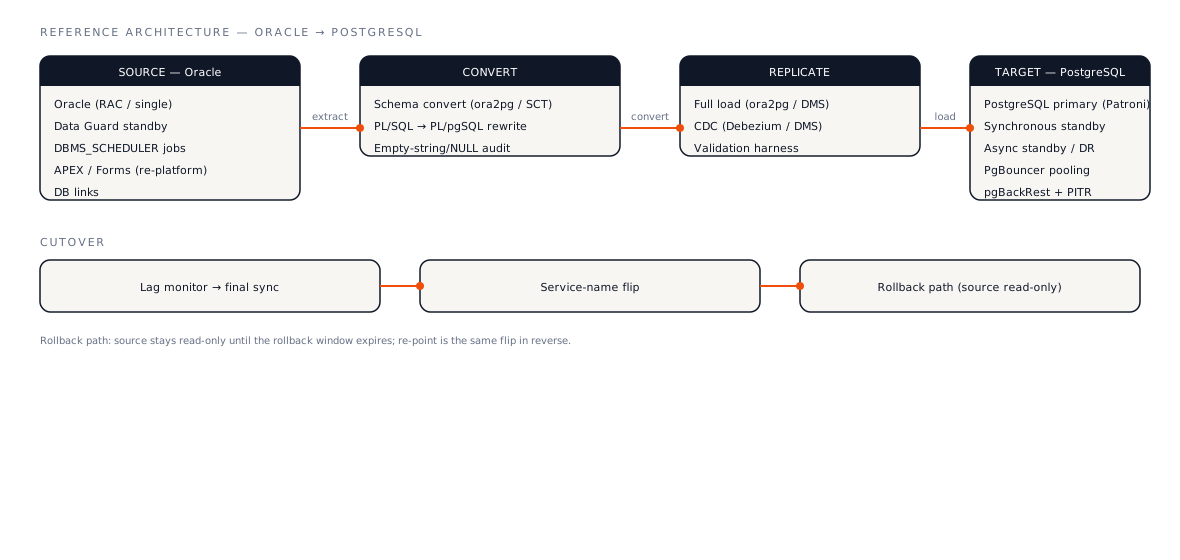
Blueprint-style target topology: Oracle source, conversion and CDC pipeline, Patroni PostgreSQL target, cutover lane.
PDF · multi-page
Discovery questionnaire
16 scored discovery questions with evidence prompts and response scales — the workshop instrument for honest scoping.
XLSX · 4 sheets
Database inventory
CDB/PDB inventory, object counts, and the Oracle feature scan (RAC, Data Guard, TDE, VPD, APEX) — feeds the wave planner.
XLSX · 4 sheets
Migration wave planner
Wave sequencing, timeline, dependencies, and staffing with objective entry/exit gates per wave.
PDF · 12 checks
Rollback checklist
Triggers, re-point procedure, and rehearsal log. A rollback you have rehearsed is a plan; anything else is a hope.
02 — Architecture at a glance
Reference architecture
Source, conversion pipeline, and target in one view: extract from Oracle, convert PL/SQL, replicate with CDC, operate PostgreSQL on Patroni.
03 — Who it’s for
Built for the people doing the work
- Database and platform teams planning an Oracle → PostgreSQL migration in the next 2–4 quarters
- Architects who need to defend the business case (support economics, PL/SQL risk, timeline) to leadership
- Engineering managers wave-planning a multi-PDB estate migration
04 — How to use it
Run it like a program, not a download
- Run the questionnaire with stakeholders
Complete the discovery questionnaire with your DBA, application, and infrastructure leads. Anything scoring low is a program risk that must be closed before wave 1.
- Inventory and complexity-score the estate
Use the database inventory workbook to catalog every CDB/PDB, then score per-schema conversion complexity (PL/SQL surface, DB links, scheduler jobs, APEX/Forms) to sequence waves: easy wins first, hairy workloads last.
- Decide disposition per workload
Run each significant schema group through the compatibility matrix. Not every Oracle workload should become PostgreSQL — the matrix keeps that decision explicit and defensible.
- Build the wave plan
Use the wave planner to lay out waves across 5 phases, assign owners, and set entry/exit criteria per wave. No wave starts until the prior wave's validation is green.
- Prove it before you commit
Stand up a pilot migration of one representative PDB through full validation (schema parity, data parity, performance, operational). Pilot results calibrate the whole program estimate.
05 — Get the full pack
Unlock the questionnaire + workbooks + rollback runbook
Free for practitioners. We ask for a work email so an architect — not a drip campaign — can follow up if your answers raise flags.
06 — Keep going
Pair the pack with an assessment
Recommended next step
Database Modernization Assessment
Run the interactive assessment, then compare its output against your pack scores — the two together scope an engagement honestly.
Instant download
Reference architecture (SVG)
One-page blueprint: source, pipeline, Patroni target, cutover lane.
Talk to an Architect
Bring a completed pack to your discovery call
It compresses weeks of fact-finding into one working session — and the scoring shows us both where the risks are.