Free Pack · Database Operations
PostgreSQL Health & Performance Pack
A production PostgreSQL health check you can run yourself: a 24-question diagnostic questionnaire, a 20-point readiness checklist, a remediation decision matrix, a 5-phase tuning project plan, and a validation test plan — built for teams inheriting or scaling PostgreSQL estates.
01 — Inside the pack
What’s inside
Four working artifacts. The checklist and the architecture diagram download instantly; the questionnaire and the decision workbook — the high-value bundle — are free with a work email.
PDF · multi-page
Discovery questionnaire
24 scored discovery questions across 6 sections with evidence prompts, response scales, and a scoring guide — the workshop instrument for honest scoping.
XLSX · 4 sheets
Decision workbook
Excel workbook: decision matrix with auto-weighted scoring and 1–5 rating validation, phased project plan with owners and deliverables, and a validation test plan with result tracking.
PDF · 20 checks
Readiness checklist
20-point readiness checklist across 5 categories with sign-off blocks — use as phase entry criteria and go/no-go gates.
SVG · one page
Architecture diagram
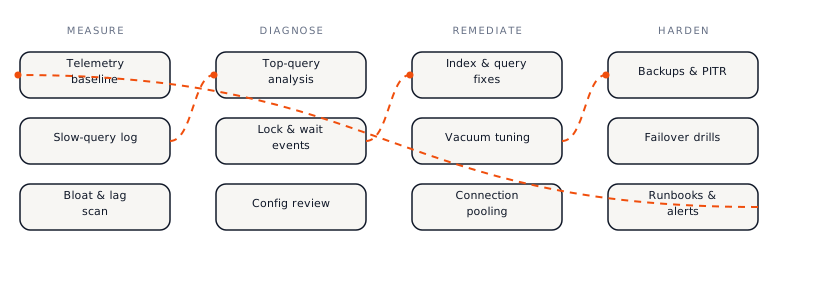
One-page blueprint-style architecture diagram — print it for the workshop wall or drop it into your deck.
02 — Architecture at a glance
Health-check loop
Measure, diagnose, remediate, harden — then keep measuring. Health is a loop, not a project.
03 — Who it’s for
Built for the people doing the work
- DBAs and platform engineers newly responsible for PostgreSQL in production
- Teams seeing slow queries, bloat, replication lag, or surprise downtime
- Architects deciding whether to tune, upgrade, re-architect, or move to managed PostgreSQL
04 — How to use it
Run it like a program, not a download
- Establish the baseline first
Complete the questionnaire against production telemetry — not opinions. Capture the checklist's key metrics (cache hit ratio, bloat estimates, lag, checkpoint frequency) before changing anything.
- Find the top 3 constraints
The questionnaire scoring surfaces your binding constraints: usually query design, vacuuming, or connection management. Fix the binding constraint first; tuning anything else is theater.
- Decide the remediation path
Run the decision matrix per cluster: tune in place vs. major upgrade vs. re-architect vs. managed service. A version two majors behind with heavy custom extensions is rarely a 'tune in place' story.
- Execute in phases with guardrails
Follow the project plan; every remediation change ships with a rollback note and a before/after measurement. No change without a metric it is supposed to move.
- Prove it with the validation plan
Re-run the validation tests after remediation and compare to baseline. Health work that cannot show a delta did not happen.
05 — Get the full pack
Unlock the questionnaire + decision workbook
Free for practitioners. We ask for a work email so an architect — not a drip campaign — can follow up if your scores raise flags.
06 — Keep going
Pair the pack with an assessment
Recommended next step
PostgreSQL Health Assessment
Run the interactive assessment, then compare its output against your pack scores — the two together scope an engagement honestly.
Talk to an Architect
Bring a completed pack to your discovery call
It compresses weeks of fact-finding into one working session — and the scoring shows us both where the risks are.